
 Andrea Micheloni
39d191ad1c
Added catalog screenshots
Andrea Micheloni
39d191ad1c
Added catalog screenshots
|
пре 1 година | |
|---|---|---|
| .github | пре 1 година | |
| images | пре 1 година | |
| screenshots | пре 1 година | |
| src | пре 1 година | |
| .gitignore | пре 1 година | |
| CHANGELOG.md | пре 1 година | |
| LICENSE | пре 1 година | |
| README.md | пре 1 година | |
| application.fam | пре 1 година | |
| lcw.png | пре 1 година |

README.md
Longwave Clock
This is a Flipper Zero app to receive and decode, or simulate, multiple time signal broadcasts with different protocols and time formats. For receiving via GPIO, an inexpensive receiver connected to a receiving pin is required.
Protocol support
DCF77 (Europe, Germany)
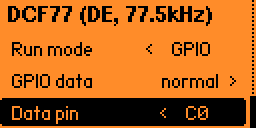


DCF77 is broadcasted from Frankfurt am Main in Germany (50.0155,9.0108) and requires an antenna tuned to 77.5 kHz.
- The radio transmission can be received all over Europe (~2000 km from the sender).
- 1 bit per second is transmitted by reducing carrier power at the beginning of every second.
- The transmission encodes time, date as well as catastrophe and weather information (encrypted, not decoded).
MSF (Europe, United Kingdom)
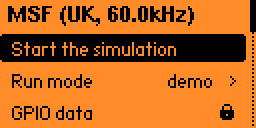

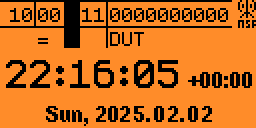
MSF (Time from NPL/Rugby clock) is broadcasted from Anthorn in the UK (54.9116,-3.2785) and requires an antenna tuned to 60 kHz (as does WWVB).
- The radio transmission can be received over most of western and northern Europe.
- The transmission encodes time, date as well as DUT1 bits (difference between atomic and astronomical time).
- The app only supports the slow code at 120 bits per minute, of which only 60bits are encoded.
- Same frequency as WWVB - in Europe you will receive this signal through a WWVB receiver.
WWVB (North America, US)
WWVB transmits on 60 kHz and is on the backlog for the Longwave app.
If you're based in the US and would like to help: PRs are welcome!
GPIO modules
The app supports a demonstration mode as well as GPIO mode. For GPIO mode, external modules are required.
In GPIO mode the following configuration is available (per protocol):
- GPIO data: use "inverted" if the module outputs logic high to the data pin when the sender signal is low (hopefully rare).
- Data pin: this configures the receiving pin on the flipper, C0 is the default and recommended pin.
Supported modules
The following shows modules that I own and have been successfully tested for reception.
77.5 kHz module (DCF77)

You can find this type of module by searching for "DCF77 module" in any electronics online shop.
60.0 kHz module (MSF, WWVB)

Search for "WWVB module" in any electronics online shop. This applies even if you want to receive MSF instead: they use the same frequency.
Pinout
The modules I checked are pretty much the same, here is the common pinout configuration I found and tested. Please check with the manufacturer, as yours might be different and you may cause damage by wiring the module incorrectly.
- VDD: flipper pin 9 (3V3)
- GND / unlabeled: flipper pin 11 (GND)
- PON / P: power on, asks for "logic low", using flipper pin 11 (GND)
- OUT / T: the data signal, using flipper pin 16 (C0)