
 WillyJL
26d2480360
Merge uv_meter_as7331 from https://github.com/michaelbaisch/uv_meter
WillyJL
26d2480360
Merge uv_meter_as7331 from https://github.com/michaelbaisch/uv_meter
|
1 год назад | |
|---|---|---|
| .. | ||
| .github | 1 год назад | |
| assets | 1 год назад | |
| images | 1 год назад | |
| magic_numbers | 1 год назад | |
| scenes | 1 год назад | |
| screenshots | 1 год назад | |
| views | 1 год назад | |
| .gitignore | 1 год назад | |
| .gitsubtree | 1 год назад | |
| AS7331.cpp | 1 год назад | |
| AS7331.hpp | 1 год назад | |
| CHANGELOG.md | 1 год назад | |
| DESCRIPTION.md | 1 год назад | |
| LICENSE | 1 год назад | |
| README.md | 1 год назад | |
| application.fam | 1 год назад | |
| uv_meter.png | 1 год назад | |
| uv_meter_app.cpp | 1 год назад | |
| uv_meter_app.hpp | 1 год назад | |
| uv_meter_app_i.hpp | 1 год назад | |
| uv_meter_event.hpp | 1 год назад | |

README.md
UV Meter
A Flipper Zero application designed to measure ultraviolet (UV) radiation levels using the AS7331 sensor. It supports individual measurements for UV-A, UV-B, and UV-C wavelengths. The easiest way to hook everything up is to use a breakout board, such as the one from SparkFun. The application is available in the Flipper App Catalog and comes pre-installed on some custom firmware builds, such as the Momentum Firmware.

Motivation
Have you heard that sitting behind a window protects you from sunburn? Sounds good, right? Unless you do a bit of research and find it's only kind of true. While potentially some UV-B (the stuff that causes immediate sunburn) gets blocked, a lot of UV-A could still get through. And guess what? UV-A plays a role in developing melanoma—a deadly form of skin cancer. Now it almost sounds even more dangerous: you lose the immediate “sunburn feedback” yet still face a long-term risk.
It gets even more complicated because it depends on the specific type of window and possible surface treatments; I have also heard that some car windows might be better in this regard. In the end, things seem less predictable, with more questions than before. And it doesn't stop there: do my sunglasses really work? Does my shirt actually protect me? How bad is it really in the shade or on a cloudy day?
What we need is data. Being able to actually measure something can be surprisingly empowering. I found the AS7331 sensor, which can independently measure UV-A, UV-B, and UV-C—and this project was born.
In general, it's surprising how low the maximum daily exposure durations actually are (based on the 2024 TLVs and BEIs by the ACGIH). Sure, compared to direct sunlight, you're better off behind a window, in the shade, or under clouds—but probably not as much as you'd expect.
In some of my measurements, the safe daily exposure duration, for example, tripled—but when you're starting with just 3 minutes, tripling still leaves you under 10 minutes. My takeaway? I should protect my eyes and skin more than I once thought necessary.
https://github.com/user-attachments/assets/cabb948c-9c79-4a1d-aab7-8789f0833f28
Wiring
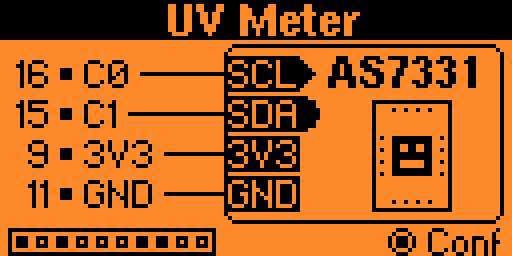
Connect the AS7331 sensor to your Flipper Zero via I²C:
| Sensor Pin | Flipper Zero Pin |
|---|---|
| SCL | C0 [pin 16] |
| SDA | C1 [pin 15] |
| 3V3 | 3V3 [pin 9] |
| GND | GND [pin 11 or 18] |
By default, the application scans all possible I²C addresses for the sensor. However, you can manually set a specific address in the settings menu, accessible by pressing the Enter button.
Usage
Once connected, the application automatically displays real-time UV measurements. The main screen shows individual UV-A, UV-B, and UV-C readings. Beneath the numbers you see the currently used unit (µW/cm², W/m² or mW/m²).
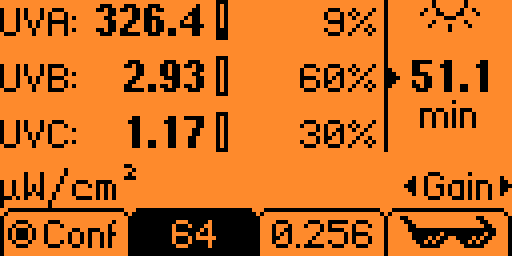
Next to each UV reading is a small meter indicating the raw sensor value. If this value is too high or too low, a warning symbol will appear, signaling potential sensor overexposure or underexposure. This condition will probably result in unreliable measurements. Adjusting the Gain and Exposure Time settings (similar to camera ISO and shutter speed) at the bottom of the screen can help correct this.
In addition to direct sensor measurements, the application provides an interpretation of this irradiance data on human safety, displayed on the right side of the screen. The time (in minutes) indicates the recommended maximum daily exposure duration during an 8-hour work shift, based on the 2024 Threshold Limit Values (TLVs) and Biological Exposure Indices (BEIs) published by the American Conference of Governmental Industrial Hygienists (ACGIH).
Since UV radiation poses greater risks to the eyes, the app includes a setting to specify whether your eyes are protected. This adjusts the maximum daily exposure duration according to ACGIH recommendations.
The displayed percentages indicate how much each UV type (UV-A, UV-B, UV-C) contributes to the maximum daily exposure. This helps illustrate that higher sensor readings don't necessarily mean a greater health risk; for example, even though UV-A sensor values are typically higher, they usually contribute less to the recommended maximum exposure limit compared to UV-B or UV-C.
When following the maximum daily exposure duration, the TLV/BEI guidelines ensure:
“[...] nearly all healthy workers may be repeatedly exposed without acute adverse health effects such as erythema and photokeratitis.”
Magic Numbers
In the source code, specifically the uv_meter_data_calculate_effective_results() function, you'll find some numbers that might look mysterious ("magic numbers"). They're used to calculate the maximum daily UV exposure duration based on sensor readings:
// Weighted Spectral Effectiveness
double w_spectral_eff_uv_a = 0.0002824;
double w_spectral_eff_uv_b = 0.3814;
double w_spectral_eff_uv_c = 0.6047;

if(eyes_protected) { // 😎
    // w_spectral_eff_uv_a is the same
    w_spectral_eff_uv_b = 0.2009;
    w_spectral_eff_uv_c = 0.2547;
}
You might wonder, "Where do these numbers come from?" Good question! To uncover the full story behind these values, check out the detailed explanation in the Magic Numbers documentation.
Disclaimer
This application is provided for informational purposes only and should not be used as a sole basis for safety-critical decisions. Always follow official guidelines, regulations, and professional advice regarding UV exposure. The developer assumes no responsibility for any damages, injuries, or consequences arising from decisions or actions based on the information provided by this application.